
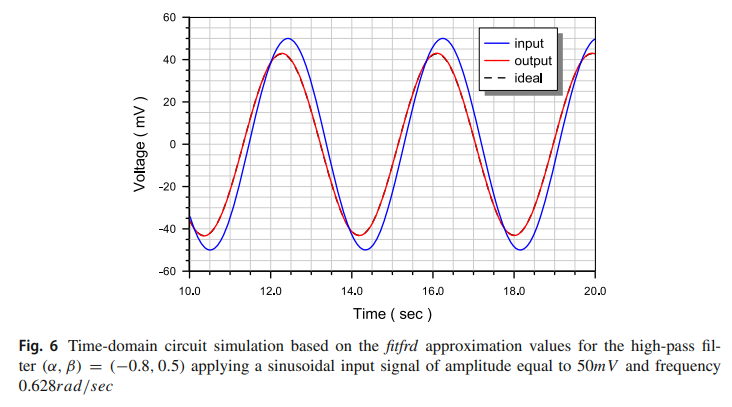
Double Exponent Fractional-Order Filters: Approximation Methods and Realization
The main goal of this work is to exploit different tools in order to approximate a general double exponent fractional-order transfer function. Through the appropriate selection of the two fractional orders of this function, different types of filters can be derived. The investigated approximation tools are either curve fitting based tools or the Padé approximation tool, and the derived approximated transfer functions in all cases have the form of rational integer-order polynomials, which can be easily realized electronically. © 2020, Springer Science+Business Media, LLC, part of Springer
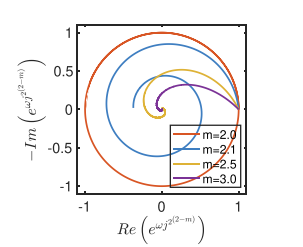
Decoupling the magnitude and phase in a constant phase element
The success of fractional-order fractance (FOF) as a modeling tool in (photo)bio(electro)chemical systems can be readily gauged by the large body of research work that has been conducted over the past few years in terms of materials fabrication, building integer-order emulators of their behavior, as well as applications in filter design, controller design, modeling of energy storage devices and biomaterials. The impedance of FOF has the general form Zα(s)=kαsα where kα and α are real constant and s=jω is the complex Laplace number. In this work, we investigate the possibility of decoupling the
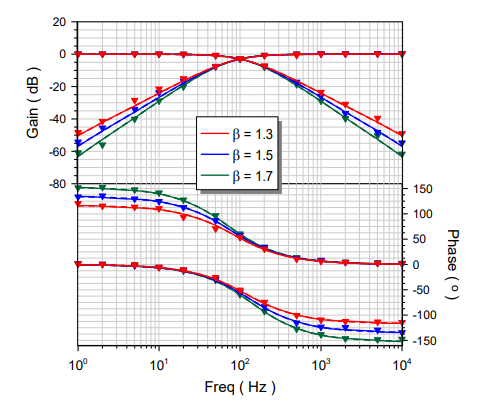
Versatile Field-Programmable Analog Array Realizations of Power-Law Filters
A structure suitable for implementing power-law low-pass and high-pass filter transfer functions is presented in this work. Through the utilization of a field-programmable analog array device, full programmability of the characteristics of the intermediate stages, as is required for realizing the rational integer-order transfer function that approximates the corresponding power-law function, was achieved, making the structure versatile. In addition, a comparison between power-law and fractional-order filters regarding the effect of the non-integer order was performed. The presented design
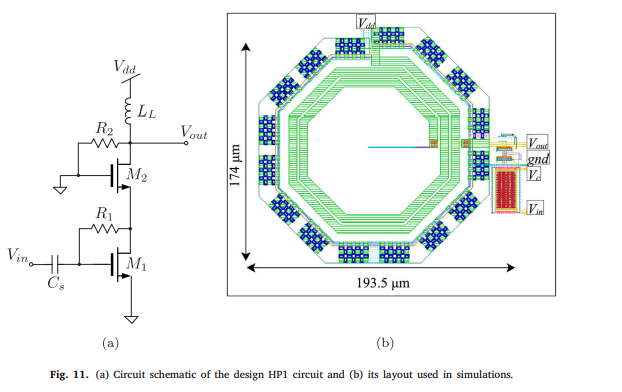
Second-order cascode-based filters
In this paper, we report on the design of a class of analog filters based on the cascode circuit structure surrounded by four impedances. The proposed topology is systematically investigated using two-port network techniques and symbolic math CAD tools. A total of 106 second-order filter circuits can be obtained from this class including 9 low-pass filters, 6 high-pass filters, 73 bandpass filters, 6 band-stop filters, and 12 gain equalizer/all-pass filters. Post-layout simulations in 65-nm CMOS technology of selected members of this family of filters are provided and prove its correct
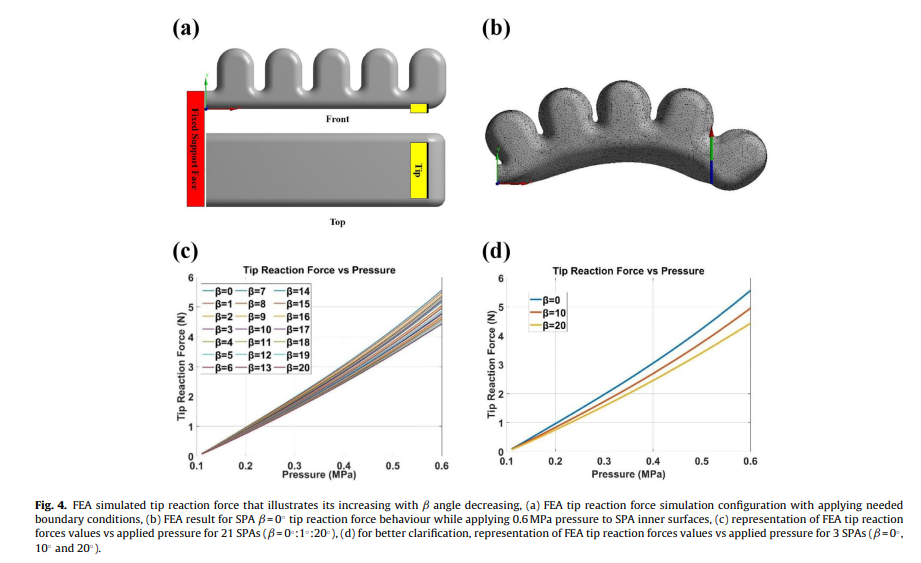
Design and implementation of variable inclined air pillow soft pneumatic actuator suitable for bioimpedance applications
The technological revolution has caused the modernization of human–machine relationship changing our approach in problem solving our society issues and deviated the science of robotic all together. An example for one of the most important pawn in this revolution is soft robotics, the soft robots are robots that are made of deformable materials that provide an alternative approach to rigid robots. The soft pneumatic actuator (SPA) is one of the most widely used and studied form of this type of robotics. In this study, a new geometrical parameter of the SPAs is introduced by studying the effect
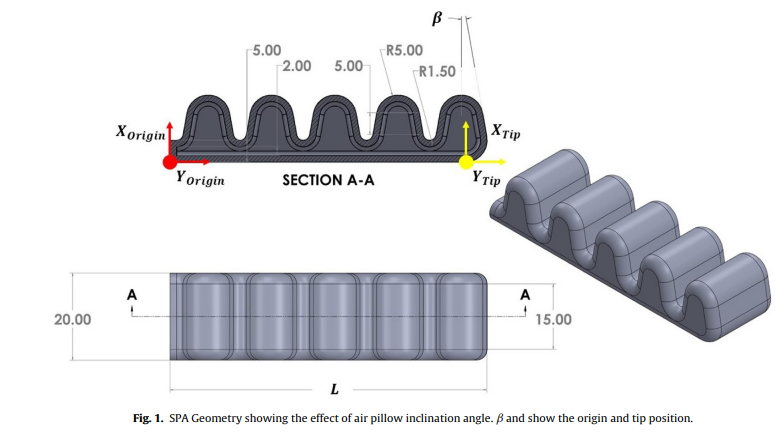
Theoretical and experimental investigation study of data driven work envelope modelling for 3D printed soft pneumatic actuators
In the last decade, soft robotics is considered one of the most widely researched fields in robotics, as it has many advantages and more versatile use than rigid robotics. Soft robots are flexible, which enable them to metaphorically complex designs, enabling them to imitate the movement of living things. In this article, the use of regression models with finite element analysis (FEA) data is compared with neural network (NN) models trained on visual feedback data. The effect of the soft pneumatic actuator (SPA) air pillow inclination angle (β) under positive and vacuum pressure on the
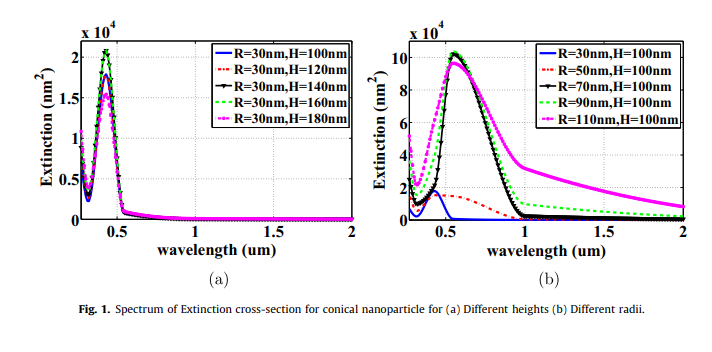
J-V characteristics of plasmonic photovoltaics with embedded conical and cylindrical metallic nanoparticles
Plasmonic photovoltaics (PVs) are promising structures that improve thin-film photovoltaics performance, where optical absorption is improved via embedding metallic nanoparticles in the PV's active layer to trap the incident optical wave into the photovoltaic cell. The presented work investigates the design of PV with both structures of conical and cylindrical metallic nanoparticles through studying their extinction cross-sections and electric field distributions. Also, the impact of these nanoparticles in silicon PVs on the optical absorption enhancement is investigated. The figure of merit
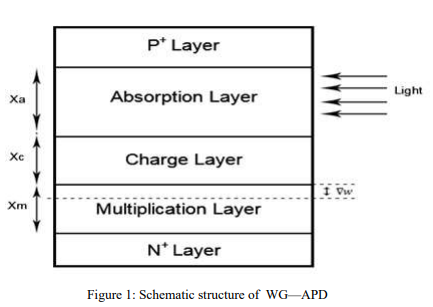
A Stochastic Modeling of the Gain in Waveguide Avalanche Photodetectors (WG-APDs)
Waveguide photodetectors are considered as a promising candidate for high speed photodetection where the tradeoff between the transit time bandwidth and the quantum efficiency is overcome as the incident optical signal and the photogenerated carriers move in perpendicular directions. In WG-Avalanche Photodetectors (WG-APDs), the avalanche multiplication gain enhances the photocurrent of the photodiodes. In these photodiodes, the inaccuracies in the ionizations coefficients of the photogenerated electrons and holes and in the dimensions of the multiplication layer affect the multiplication gain
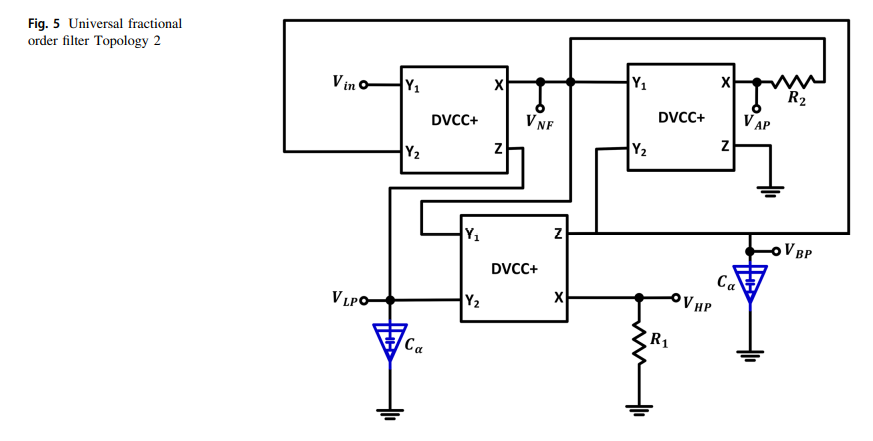
α -order universal filter realization based on single input multi-output differential voltage current conveyor
Two voltage-mode topologies single input multi-output universal fractional filters with high input impedance are proposed. The proposed analog filters consist of three DVCC+ blocks, two grounded capacitors and two resistors targeting the minimum passive elements. The proposed topologies provide a realization for all standard fractional filter functions (HP, LP, BP, AP and notch filter). The effect of Fractional order on filter responses in the range of α from 0.7 to 1.2 was studied. Fractional order has been investigated for different filter responses in terms of cutoff, gain, phase and noise
Optimal fractional-order PI with DC-DC converter and PV system
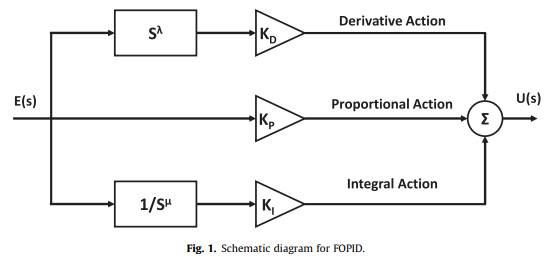
This paper presents a design and analysis for the PV system with a DC-DC boost converter controlled by the Fractional Order PI controller (FOPI). The study includes obtaining the optimal parameters for the PV model and the operating parameters for the FOPI controller. The first part's objective function is to search a five-parameter model based on the data-sheet given by commercial PV modules for a single-diode (SD) model. In the second part of the study, a detailed comparison is executed versus P, PI, PID, and FOPI controllers showing the effect of implementing Fractional order controllers on