
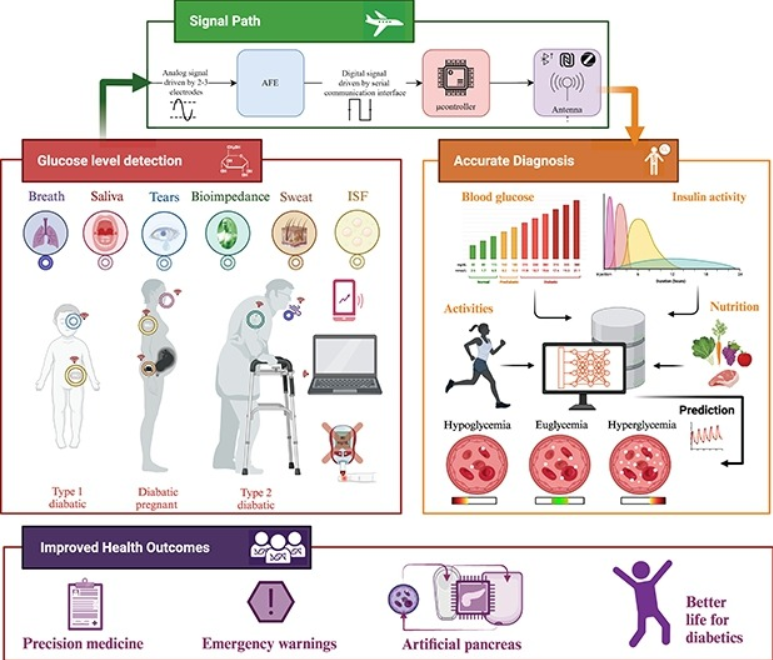
Wearable devices for glucose monitoring: A review of state-of-the-art technologies and emerging trends
Diabetes is a chronic condition that is characterized by high blood glucose levels and can cause damage to multiple organs over time. Continuous monitoring of glucose levels is essential for both diabetic and non-diabetic individuals. There have been major developments in glucose monitoring technology over the past decade, which have been driven by research and industry efforts. Despite these significant advancements, the area of glucose biosensors still faces significant challenges. This paper presents a comprehensive summary of the latest glucose monitoring technologies, including invasive
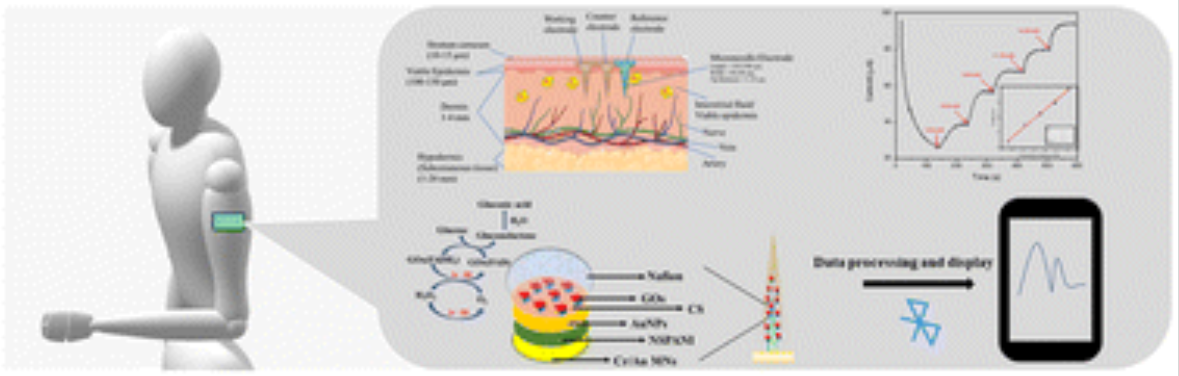
Early detection of hypo/hyperglycemia using a microneedle electrode array-based biosensor for glucose ultrasensitive monitoring in interstitial fluid
Diabetes is a common chronic metabolic disease with a wide range of clinical symptoms and consequences and one of the main causes of death. For the management of diabetes, painless and continuous interstitial fluid (ISF) glucose monitoring is ideal. Here, we demonstrate continuous diabetes monitoring using an integrated microneedle (MN) biosensor with an emergency alert system. MNs are a novel technique in the field of biomedical engineering because of their ability to analyze bioinformation with minimal invasion. In this work we developed a poly(methyl methacrylate) (PMMA) based MN glucose

SSHC with One Capacitor for Piezoelectric Energy Harvesting
Piezoelectric vibration energy harvesters have attracted a lot of attention as a way to power self-sustaining electronic systems. Furthermore, as part of the growing Internet of Things (loT) paradigm, the ongoing push for downsizing and higher degrees of integration continues to constitute major drivers for autonomous sensor systems. Two of the most effective interface circuits for piezoelectric energy harvesters are synchronised switch harvesting (SSH) on inductor and synchronous electrical charge extraction; nevertheless, inductors are essential components in both interfaces. This study
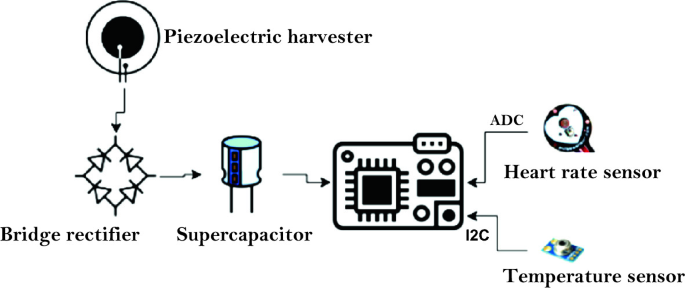
Energy Aware Tikhonov-Regularized FPA Technique for Task Scheduling in Wearable Biomedical Devices
Harvesting the energy from environmental sources is a promising solution for perpetual and continuous operation of biomedical wearable devices. Although the energy harvesting technology ensures the availability of energy source, yet power management is crucial to ensure prolonged and stable operation under a stringent power budget. Thus, power-aware task scheduling can play a key role in minimizing energy consumption to improve system durability while maintaining device functionality. This chapter proposes a novel biosensor task scheduling of energy harvesting-based biomedical wearable devices
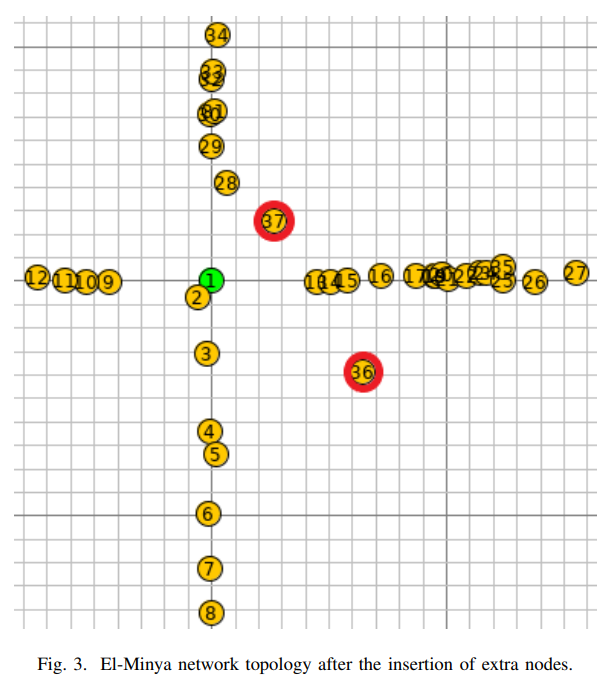
Realistic Wireless Smart-Meter Network Optimization Using Composite RPL Metric
In smart metering applications, transferring and collecting data within delay constraints is crucial. IoT devices are usually resource-constrained and need reliable and energy-efficient routing protocol. Furthermore, meters deployed in lossy networks often lead to packet loss and congestion. In smart grid communication, low latency and low energy consumption are usually the main system targets. Considering these constraints, we propose an enhancement in RPL to ensure link reliability as well as low latency. We refer to the proposed new additive composite metric as Delay-Aware RPL (DA-RPL)
Sustainable Energy-Aware Task Scheduling for Wearable Medical Device Using Flower Pollination Algorithm
Power management and energy conservation are crucial for medical wearable devices that rely on energy harvesting. These devices operate under strict power budgets and require prolonged and stable operation. To achieve this, Energy-aware task scheduling is proposed as a solution to minimize energy consumption while ensuring the continued operational capabilities of the device. our paper presents a task scheduling method using the Flower Pollination Algorithm (FPA). The proposed task scheduling focuses on managing the activity of key components such as the heart rate sensor, temperature sensor
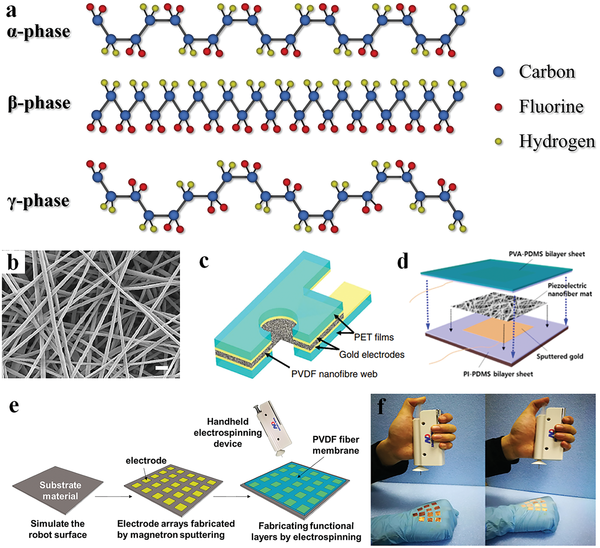
Improvement of piezoresistive pressure sensor using zig-zag shaped and PVDF material
Due to a wide range of applications in the biomedical industry, the need for flexible and wearable sensors is growing every day. A pressure sensor generates a signal based on the applied pressure. Sensors have become an integral component of our daily lives, from personal gadgets to industrial machinery. The identification of the low signal from the body necessitates the use of particularly sensitive sensors. The development of a pressure sensor that can transform the maximum input signal into an electrical output is critical. In this paper, zig-zag piezoresistors on a square diaphragm were
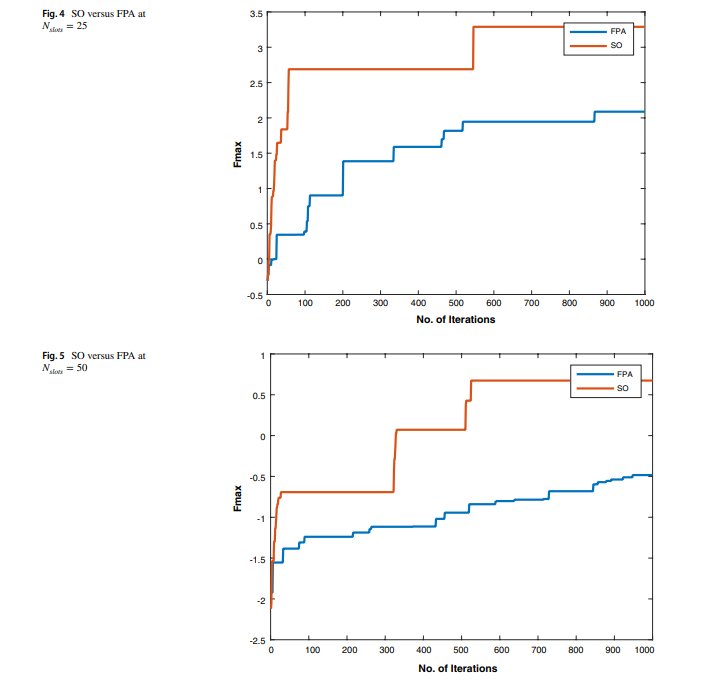
A power-aware task scheduler for energy harvesting-based wearable biomedical systems using snake optimizer
There is an increasing interest in energy harvesting for wearable biomedical devices. This requires power conservation and management to ensure long-term and steady operation. Hence, task scheduling algorithms will be used throughout this work to provide a reliable solution to minimize energy consumption while considering the system operation constraints. This study proposes a novel power-aware task scheduler to manage system operations. For example, we used the scheduler to handle system operations, including heart rate and temperature sensors. Two optimization techniques have been used to

Mathematical Techniques of Fractional Order Systems
Mathematical Techniques of Fractional Order Systems illustrates advances in linear and nonlinear fractional-order systems relating to many interdisciplinary applications, including biomedical, control, circuits, electromagnetics and security. The book covers the mathematical background and literature survey of fractional-order calculus and generalized fractional-order circuit theorems from different perspectives in design, analysis and realizations, nonlinear fractional-order circuits and systems, the fractional-order memristive circuits and systems in design, analysis, emulators, simulation
Energy Harvesting Management Unit for Wearable Devices
Energy harvesting materials and systems have become a popular study topic that is rapidly expanding. The harvesters will be used for a variety of applications, including distributed wireless sensor nodes for structural health monitoring, embedded and implanted sensor nodes for medical applications, recharging large system batteries, monitoring pressure in automobiles, powering unmanned vehicles, and running security systems in domestic settings. Components and devices at micro-macro sizes, spanning materials, electronics, and integration, have recently been developed. Energy harvesting has