
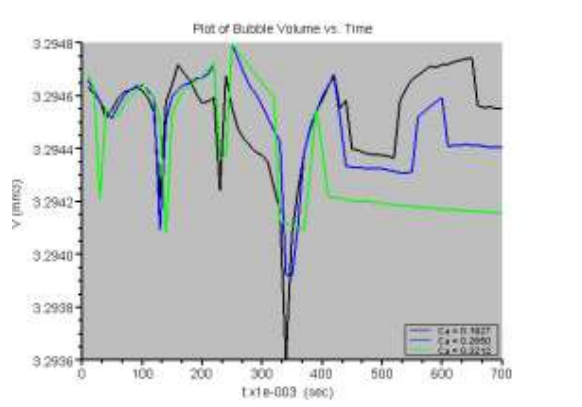
Two-dimensional front-tracking model for film evaporation
To understand the physical process involved in film evaporation, a new numerical model is created using coupled quadratic finite element formulation of the conservation equations. The heat transport equation is solved in the three different phases (solid, liquid and vapor) while the Navier-Stokes equation are solved in the two fluids. The gradient discontinuity at the liquid vapor interface provides local value of the evaporative flux density that is directly linked to the interface velocity jump through mass conservation principle and used as boundary condition for two fluid flow computations

Interfacial modification of perovskite solar cell using zno electron injection layer with pdms as antireflective coating
Recently, perovskite solar cells (PSCs) exhibits tremendous power conversion efficiency and has shown enhanced figures of merit being secured regarding cell stability. In this paper, perovskite solar cell with Zno electron injection layer is presented. The humidity degradation of the perovskite active layer and the efficiency of the cell is observed under several conditions. Using ZnO as a planner electron injection layer (EIL) instead of TiO2, the efficiency of the device significantly improved, showing low-resistance shunting pathways. Also, polydimethylsiloxane (PDMS) has been used as a

Temperature-aware adaptive task-mapping targeting uniform thermal distribution in MPSoC platforms
As on-chip integration increases, the thermal distribution becomes spatially non-uniform and varies based on the power dissipation. In this paper, we introduce a temperature-aware task-mapping algorithm to prevent hotspots and achieve a highly uniform thermal distribution using adaptive multi-threshold values. The algorithm monitors the temperature of the cores, swaps tasks when the temperature of the core is relatively higher than the average temperature of the chip. Cores are switched off if they exceed an absolute maximum temperature. Using this algorithm, reliability is enhanced by

Resistorless memristor based oscillator
This paper introduces the replacement of four and six resistors with four and six memristors at the same time for the modified single input Op-Amps oscillator. The full independency between the oscillation condition and the oscillation frequency facilitates the study. Mathematical analysis is provided for the double replacement of resistors with memristors. The whole range of operation of the memristor is taken in consideration and examined for all kind of replacements. Also, the poles of the system are presented while the existence of two, four and six memristors. © 2014 IEEE.

A generic impedance modeling technique
In this work, a generic impedance modeling technique is proposed. The technique is able to identify a circuit model that is most suitable for fitting measured impedance magnitude data using a genetic algorithm solver as well as the optimum circuit model parameters. Experimentally measured and simulated data sets with different noise levels are used to validate the technique. © 2020 Elsevier GmbH

A fractional-order dynamic PV model
A dynamic model of Photo-Voltaic (PV) solar module is important when it is utilized in conjunction with switching circuits and in grid connected applications. In this paper, a fractional-order dynamical model of a PV source is introduced. The model includes both a fractional series inductor and a parallel capacitor which are in general of two different orders allowing for extra degrees of modeling freedom. An expression for the load current is derived and the step response is investigated for different orders. It is found that the nature of the connections has a dominant effect on the response

Experimental verification of triple lobes generation in fractional memristive circuits
Recently, the triple-lobe behavior is found in the I-V characteristics of some memristive devices generating another non-zero pinchoff point. In this paper, a flux-controlled memristive model is developed to generate the triple-lobe behavior (double pinchoff points) based on a fractional second-order model. The conditions for observing triple lobes are derived besides the coordinates of the pinchoff points. Different scenarios have been considered by changing the model parameters and fractional order. Furthermore, the minimum and maximum achievable conductances are analyzed and mathematically

Fractional order oscillators based on operational transresistance amplifiers
In this paper, a general analysis of the fractional order operational transresistance amplifiers (OTRA) based oscillator is presented and validated through eight different circuits which represent two classifications according to the number of OTRAs. The general analytical formulas of the oscillation frequency, condition as well as the phase difference are illustrated for each case and summarized in tables. One of the advantages of the fractional-order circuit is the extra degrees of freedom added from the fractional-order parameters. Moreover different special cases {α = β ≢ 1, β ≢ α = 1, α ≢

Realizations of simple fractional-order capacitor emulators with electronically-tunable capacitance
A novel resistorless topology for implementing fractional-order capacitor emulators, based on the employment of Operational Transconductance Amplifiers (OTAs) as active elements, is presented in this paper. The benefits of this topology are its simplicity in terms of component count, compared to other existing topologies in the literature, in addition to its electronic tunability. The performance of the presented topology is evaluated using Cadence and the 0.35 μm CMOS process Design Kit from Austria Mikro Systeme. Experimental results using commercial OTA chips are also provided, where the

Approximation of the fractional-order laplacian Sα as a weighted sum of first-order high-pass filters
A new approximation method of the fractional-order Laplacian operator sα is introduced. The approximation is based on a weighted sum of first-order filter sections and its analytical proof is given. The optimal high-pass filter section parameters that cover six frequency decades are obtained using the flower pollination algorithm while the effect of the number of filter sections on the accuracy of the approximation is investigated. Approximations of fractional-order capacitors of orders α =0.5 and α =0.7 synthesized in Foster-II form are given as a validating example. Further, an active