
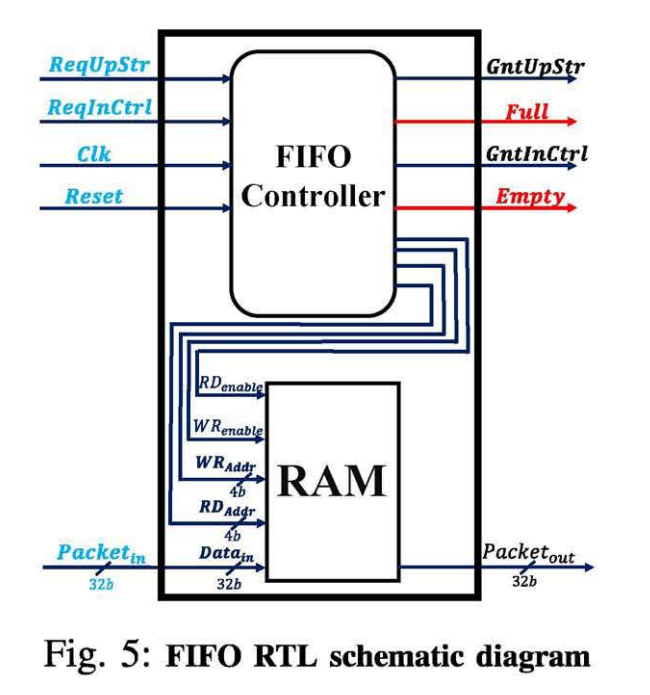
Small Area and Low Power Hybrid CMOS-Memristor Based FIFO for NoC
Area and power consumption are the main challenges in Network on Chip (NoC). Indeed, First Input First Output (FIFO) memory is the key element in NoC. Increasing the FIFO depth, produces an increas in the performance of NoC but at the cost of area and power consumption. This paper proposes a new hybrid CMOS-Memristor based FIFO architecture that consumes low power and has a small size compared to the conventional CMOS-based FIFOs. The predicted area is approximately equal to the half of that wasted in conventional FIFOs. The implementation of FIFO controller module is implemented using HDL
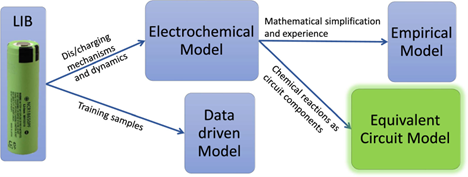
Fractional-Order Equivalent-Circuit Model Identification of Commercial Lithium-Ion Batteries
The precise identification of electrical model parameters of Li-Ion batteries is essential for efficient usage and better prediction of the battery performance. In this work, the model identification performance of two metaheuristic optimization algorithms is compared. The algorithms in comparison are the Marine Predator Algorithm (MPA) and the Partial Reinforcement Optimizer (PRO) to find the optimal model parameter values. Three fractional-order (FO) electrical equivalent circuit models (ECMs) of Li-Ion batteries with different levels of complexity are used to fit the electrochemical
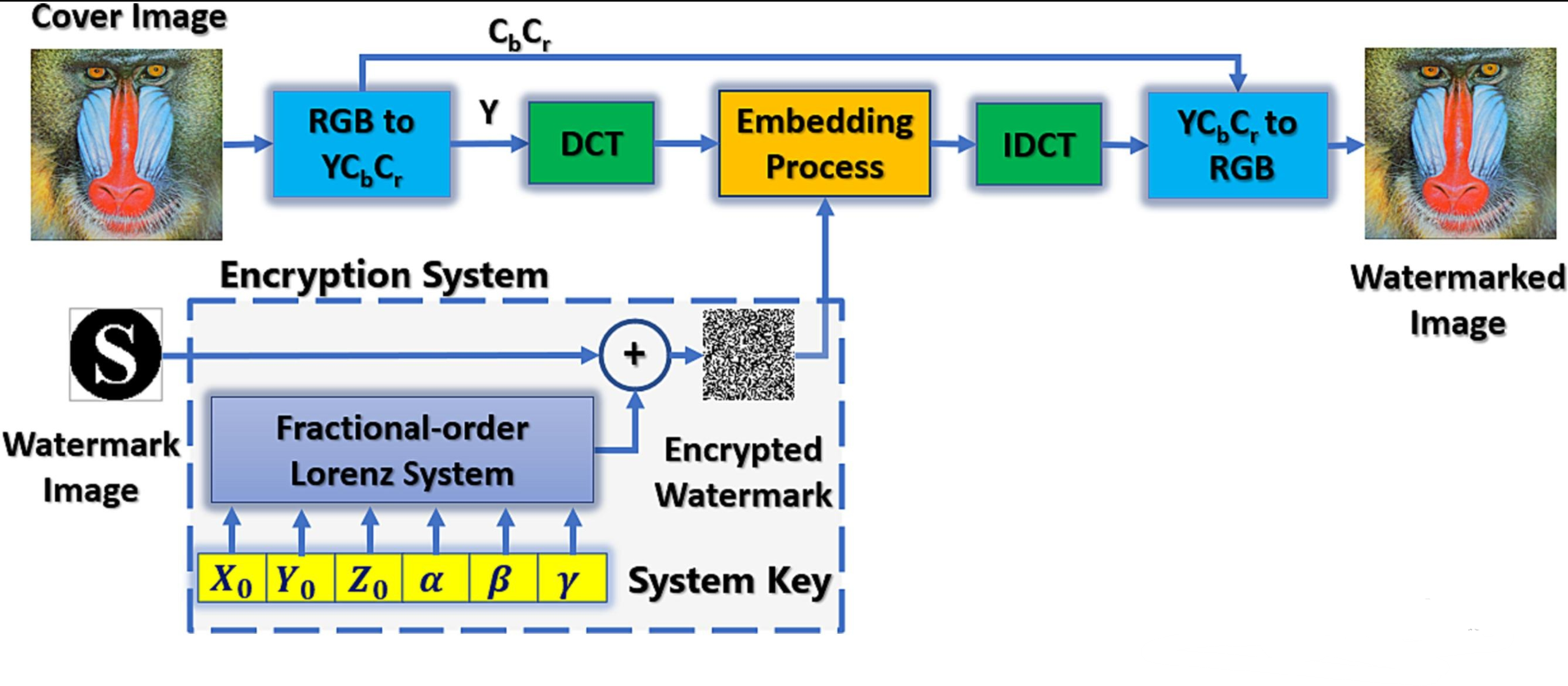
Secure blind watermarking using Fractional-Order Lorenz system in the frequency domain
This paper investigates two different blind watermarking systems in the frequency domain with the development of a Pseudo Random Number Generator (PRNG), based on a fractional-order chaotic system, for watermark encryption. The methodology is based on converting the cover image to the YCbCr color domain and applying two different techniques of frequency transforms, Discrete Cosine Transform (DCT) and Discrete Wavelet Transform (DWT), to the Y channel. Then, the encrypted watermark is embedded in the middle-frequency band and HH band coefficients for the DCT and DWT, respectively. For more

Energy Harvesting Management Unit for Wearable Devices
Energy harvesting materials and systems have become a popular study topic that is rapidly expanding. The harvesters will be used for a variety of applications, including distributed wireless sensor nodes for structural health monitoring, embedded and implanted sensor nodes for medical applications, recharging large system batteries, monitoring pressure in automobiles, powering unmanned vehicles, and running security systems in domestic settings. Components and devices at micro-macro sizes, spanning materials, electronics, and integration, have recently been developed. Energy harvesting has

Wastewater Treatment: Recycling, Management, and Valorization of Industrial Solid Wastes
Wastewater Treatment: Recycling, Management, and Valorization of Industrial Solid Wastes bridges the gap between the theory and applications of wastewater treatments, principles of diffusion, and the mechanism of biological and industrial treatment processes. It presents the practical applications that illustrate the treatment of several types of data, providing an overview of the characterization and treatment of wastewaters, and then examining the different biomaterials and methods for the evaluation of the treatment of biological wastewaters. Further, it considers the various types of

Indoor Air Quality Monitoring Systems for Sustainable Medical Rooms and Enhanced Life Quality
Indoor air pollution poses a substantial risk to human health and well-being, underscoring the crucial requirement for efficient monitoring systems. This paper introduces an advanced Air Pollution Monitoring System (APMS) tailored explicitly for indoor settings. The APMS integrates sensors and a user interface, ensuring the delivery of real-time and precise data concerning air quality parameters such as particulate matter (PM), volatile organic compounds (VOCs), carbon dioxide (CO2), as well as temperature and humidity. The proposed APMS has several advantages, including low maintenance

Novel Edge AI with Power-Efficient Re-configurable LP-MAC Processing Elements
Deep learning has become increasingly important in various fields, such as robotics, image processing, and speech recognition. However, the high computational requirements of deep learning models make it challenging to deploy them on edge & embedded devices with constrained power and area budgets. This paper proposes a novel low-power technique for implementing deep learning models on edge devices called LP-MAC (Low Power Multiply Accumulate). LP-MAC is designed for fixed-point format operations and takes advantage of reusing the input vector for MAC operations. It provides a new hardware

CPW-Fed Bow-Tie Antenna for Ambient RF Energy Harvesting Applications
This paper presents a high-efficiency bow-tie antenna for ambient RF energy harvesting at the 2.4 GHz band. Moreover, a rectifier circuit that converts the AC into DC is proposed. The antenna is fed via a CPW transmission line where a quarter wavelength transformer is inserted to match the slot bow-tie with the 50-ohm transmission line. The structure is simulated using CST software, and results are validated using HFSS. The antenna's directivity, efficiency, and bandwidth are 6.63 dBi, 89.9 %, and 0.946 GHz respectively, as simulated using CST. The antenna is fabricated on a single-layer
IOT-based air quality monitoring system for agriculture
Air quality assessment has been discussed for urban environments with a high degree of industrialization, as they are infested with hazardous chemicals and airborne pollutants. The assessment is carried out by monitoring stations, that basically support limited areas while leaving large geographical areas uncovered. The expansion in the agriculture sector directed us towards air quality assessment on the farms. This is because research has shown that crops can be injured when exposed to high concentrations of various air pollutants, while also affecting farmers' health states. But those air

Threshold Energy Based LEACH-K Effect on the Accessibility of Wireless Sensor Networks
This paper aims to deliver an exhaustive investigation on the threshold energy parameter's direct impact on the Cluster Head (CH) selection phase in Low-Energy Adaptive Clustering Hierarchy Based on K-Means (LEACH-K) protocols. The most prominent threshold energy selection criterion out of the scarcely available research on the LEACH-K threshold energy parameter is used to simulate the LEACH-K protocol. Simulations are carried out on scaled-up Wireless Sensor Networks (WSNs) in terms of size and number of nodes. An analysis is performed on the life-cycle of the CH selection process, which